2 Sept 2026 · 2 months ago
Walled Kitchen Garden: A Compact Minecraft Growing Plot
Give a cottage a productive garden with a low stone boundary, wheat beds, and a central watering point.
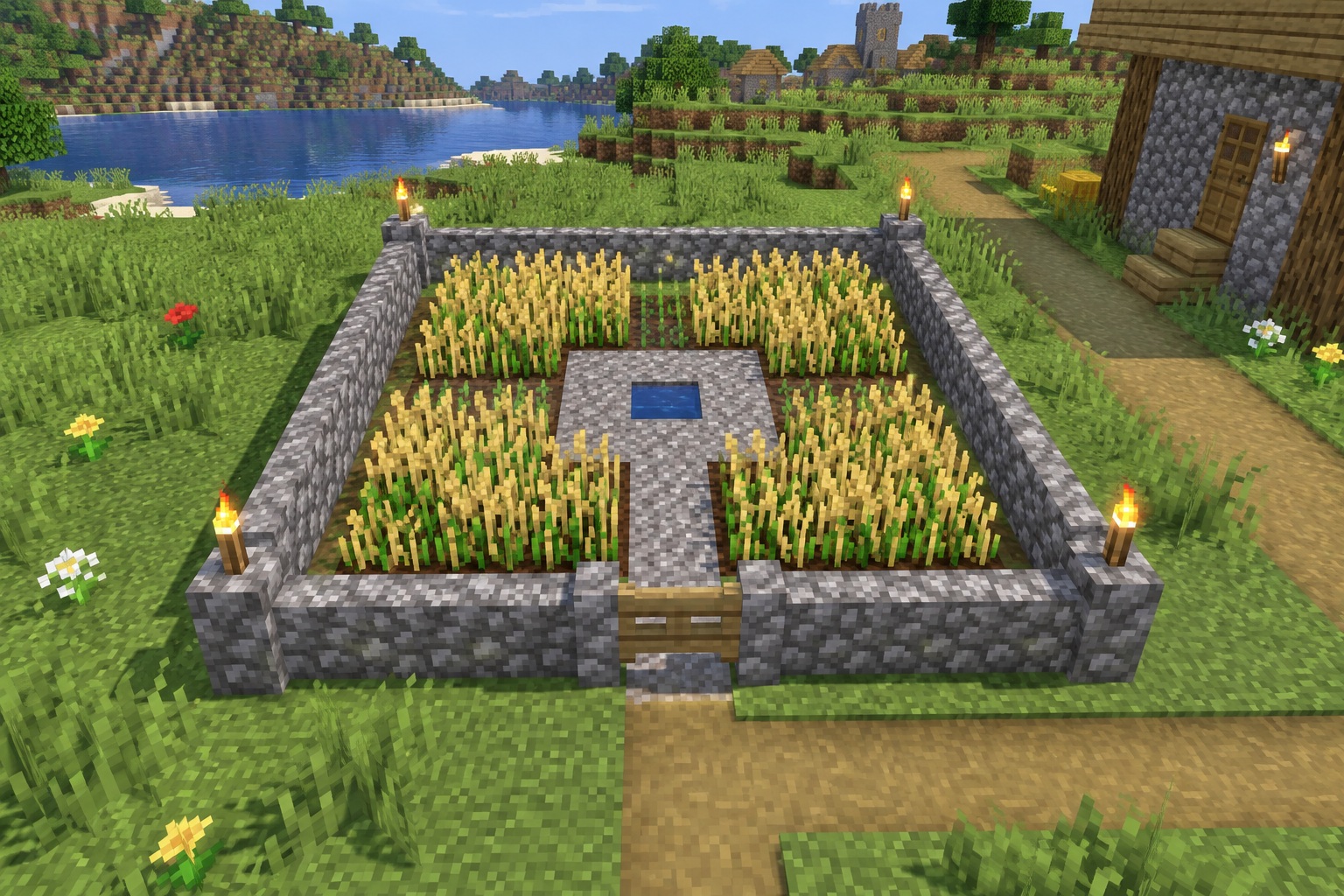
A small garden makes a cottage feel lived in. This square plot combines a low cobblestone boundary with a simple gravel approach, a central water source, and wheat beds around it. It fits beside a farmhouse or behind a village kitchen without becoming a sprawling field.
The footprint is 9 × 9 blocks, enclosing a 7 × 7 planting area. The layout has 38 crop positions, 10 gravel cells, and one water cell. The walls occupy a single block layer above the ground.
The numbered diagrams define exact placement. Hero and gallery images are AI-generated appearance references, not in-game screenshots; proportions and small details may vary.
Materials
- **31 cobblestone walls:** use the wall item, rather than full cobblestone cubes.
- **1 oak fence gate:** the entrance.
- **10 gravel blocks:** eight around the water and two for the approach.
- **38 wheat seeds:** one per farmland cell.
- **1 water bucket:** fill the central source.
- **4 torches:** one on each wall corner.
- **38 dirt blocks to till:** reuse the existing ground where possible.
- A hoe and shovel; retain solid ground beneath the gravel and water.
These counts describe placed materials. Landscaping outside the square is extra.
How to build
1. Mark the planting beds and central water
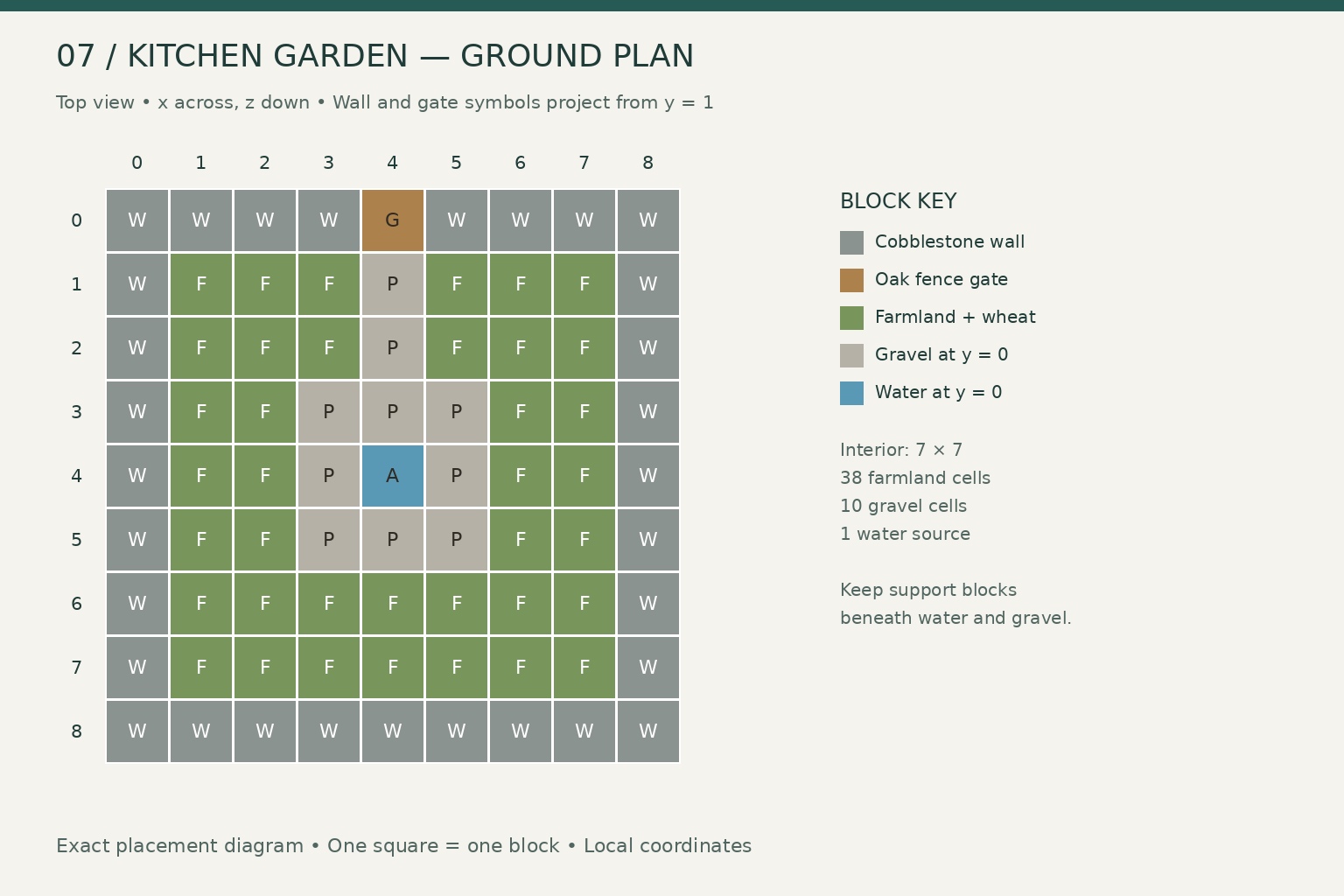
Face the entrance. Number columns x = 0–8 from left to right and rows z = 0–8 from front to back. Call the ground-block layer y = 0. Keep the whole area level before changing the surface.
The interior is x = 1–7, z = 1–7. Remove the block at x = 4, z = 4, y = 0, keeping a solid block beneath it at y = -1. Fill the opening with one water source.
Replace the other eight cells of the central 3 × 3 square, x = 3–5 and z = 3–5, with gravel. This makes a complete ring around the water. Add two more gravel blocks at x = 4, z = 1 and 2, connecting the ring to the entrance.
Leave dirt in every other interior cell. There should be 38 dirt cells, ready to till. Check that the water is contained, that all ten gravel blocks have solid support, and that the approach reaches the ring without a gap.
2. Finish the boundary and plant the beds
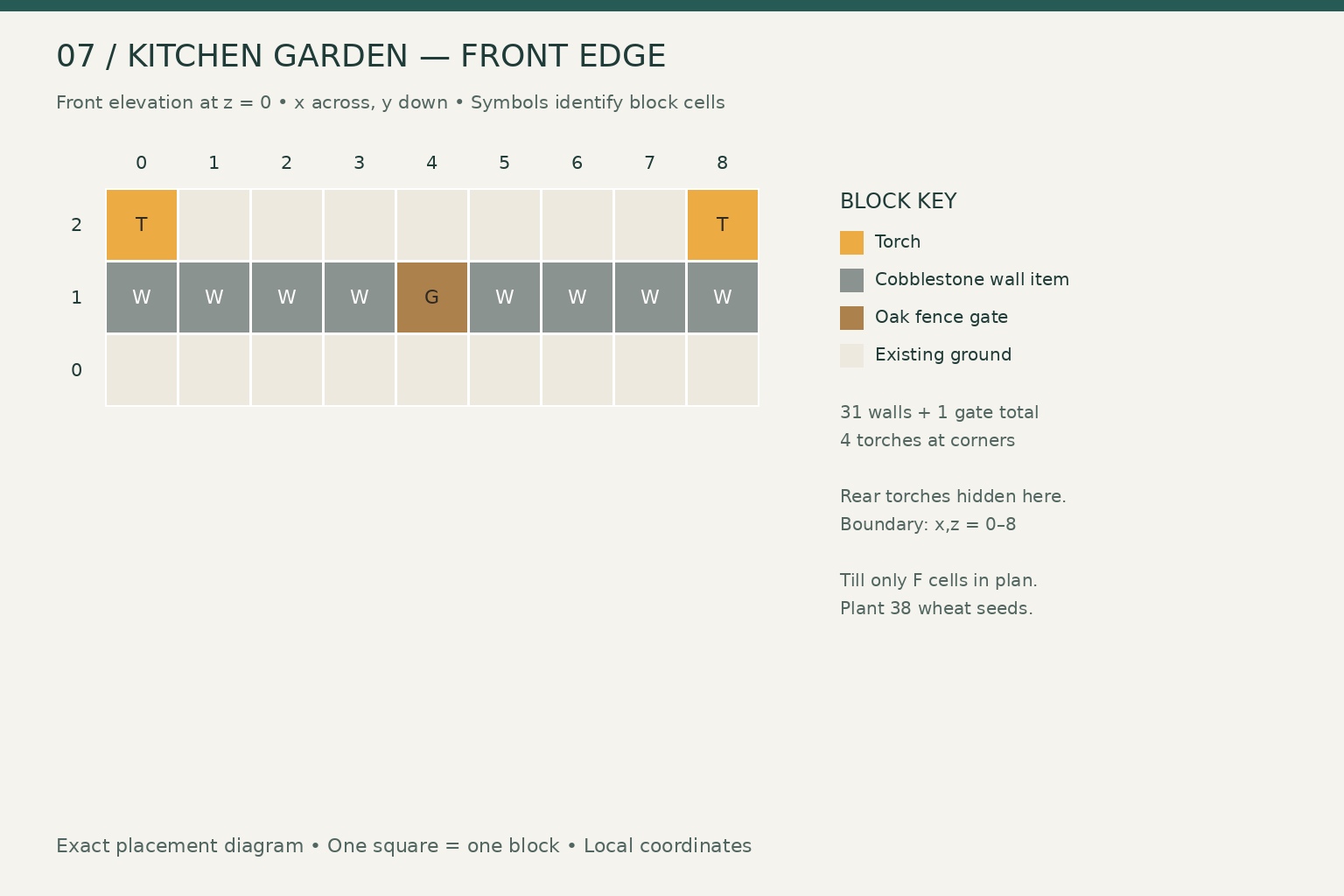
At y = 1, place cobblestone walls around the full outer edge of the 9 × 9 square, except at x = 4, z = 0. The perimeter contains 32 positions; leaving the entrance uses 31 walls.
Install an oak fence gate in the gap at x = 4, z = 0, y = 1. Its closed barrier should run across the entrance, joining the neighboring walls. Check that it opens onto the gravel approach.
Put torches on top of the four corner walls at (0,0), (8,0), (0,8), and (8,8) in x/z. The torches occupy y = 2.
Use the hoe on the 38 remaining interior dirt cells at y = 0, then plant one wheat seed on each. Leave the gravel, water, and boundary cells unchanged. The appearance images show grown wheat; your newly planted garden will start with small seedlings.
Keep the route from the gate to the central ring clear. The outer beds are reached by walking carefully over the farmland; the gravel is a small working area rather than a path beside every crop. Avoid jumping onto the tilled soil.
Gallery
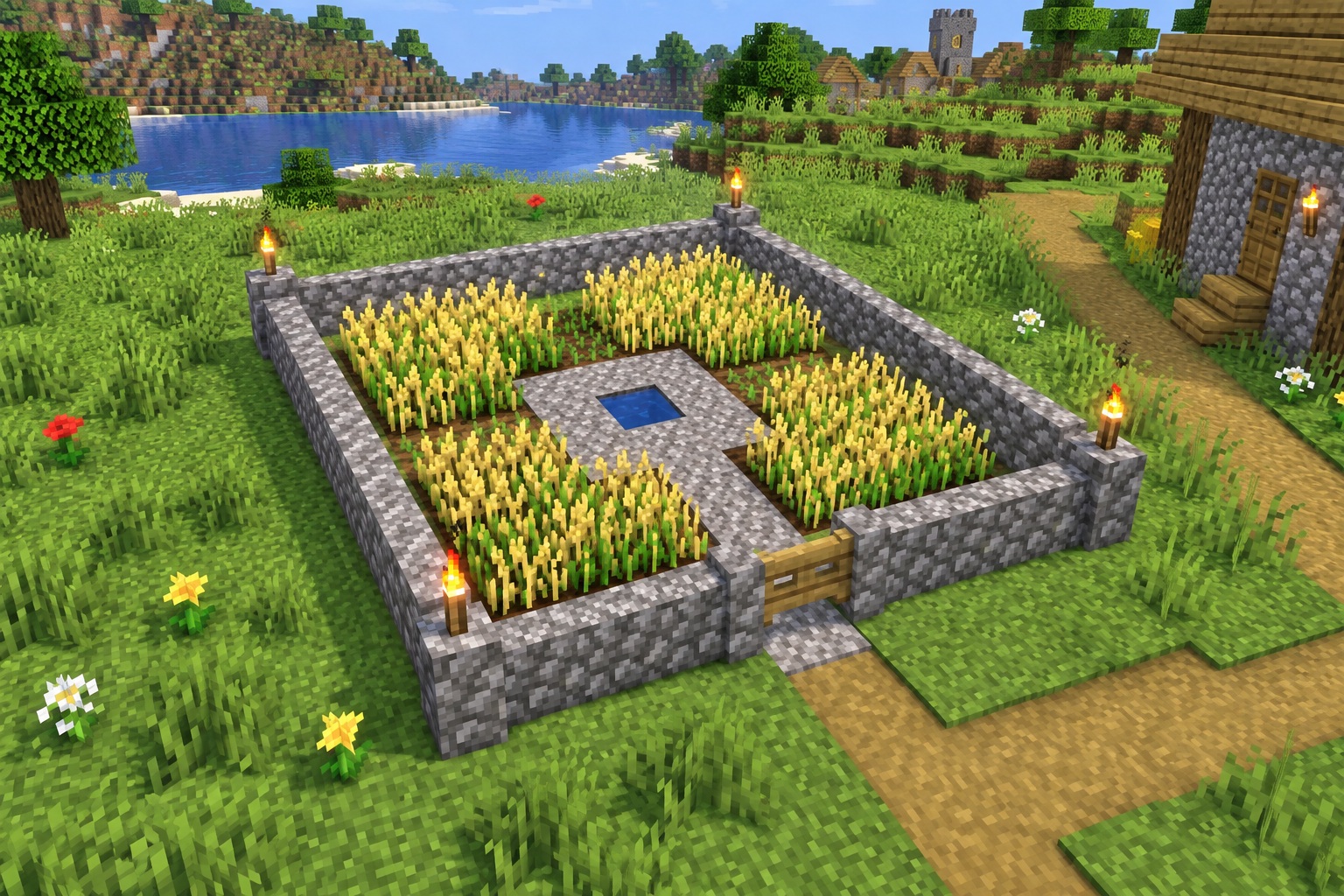
The low boundary frames the crops while keeping the garden visible from the nearby path.
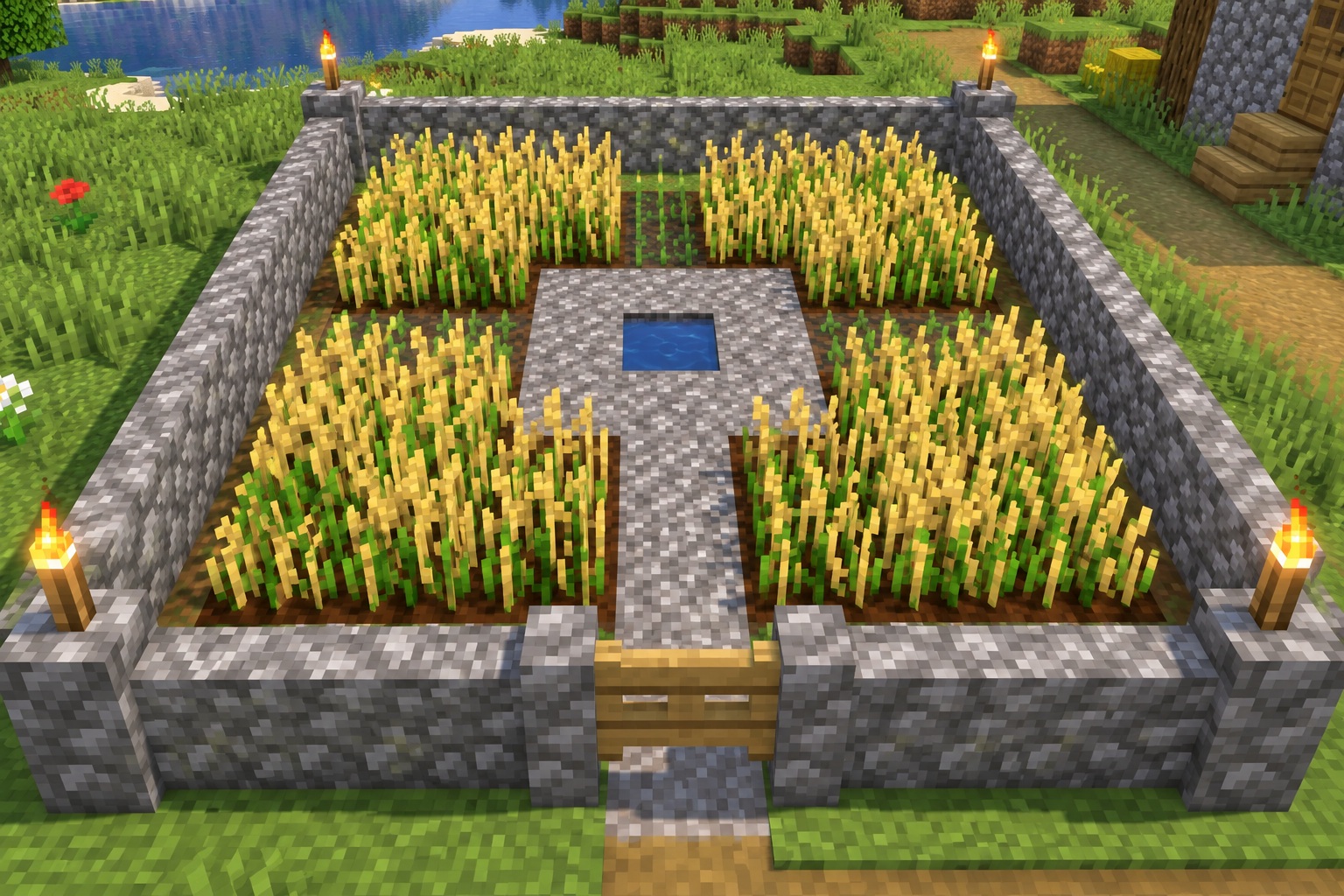
The gravel ring gives the plot a clear center and room to turn without filling the garden with paths.
Leave a note
Notes are submitted for moderation and are not published automatically.